

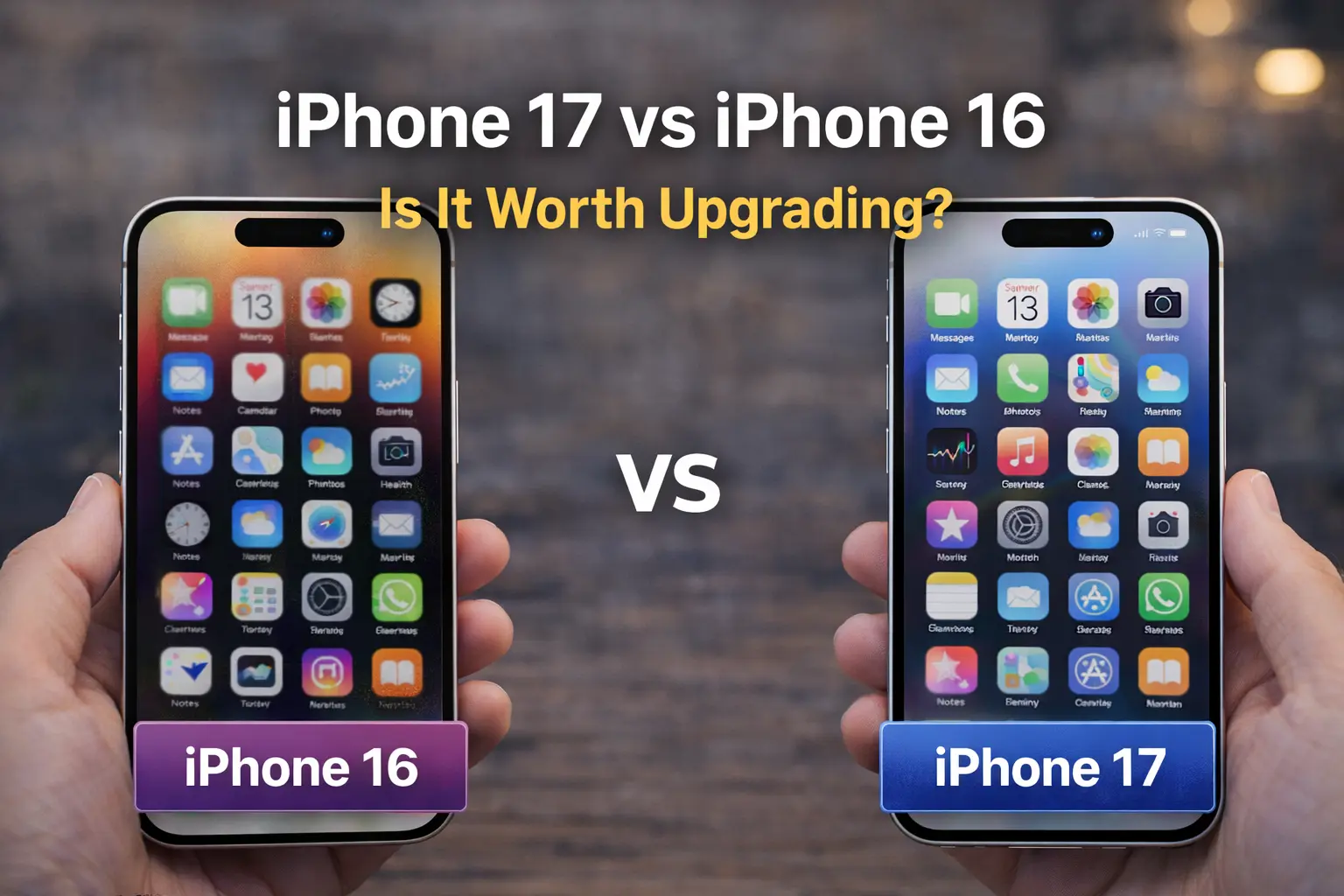
iPhone 17 vs iPhone 16 is one of the most common comparisons right now, especially if you’re thinking about upgrading your phone. If you’re deciding between the iPhone 17 and the iPhone 16, it can feel a bit confusing at first. On the surface, both phones look almost identical, and Apple hasn’t made any dramatic design changes.
But from real use, the differences aren’t about how they look — they’re about how they feel day to day.
What I’ve noticed with newer iPhones is that Apple focuses more on refining the experience rather than completely changing everything. And that’s exactly what’s happened here with the iPhone 17.
So instead of just listing specs, I’ll break this down properly — what actually changed, what you’ll notice in real use, and whether it’s worth upgrading.
Table of Contents
Quick Answer
- iPhone 17 introduces a smoother 120Hz display
- It runs on a newer A19 chip for better long-term performance
- Camera improvements focus on low-light and consistency
- Battery life is slightly better due to efficiency
- Best upgrade if you’re using iPhone 13 or older
- Not essential if you already have iPhone 15 or 16
Design & Build – Familiar, But More Refined
At first glance, both phones look almost the same — and that’s expected.
Apple has kept:
- Flat-edge design
- Glass back
- Aluminium frame
- Dual camera layout
However, the iPhone 17 feels slightly more refined:
- Slimmer bezels
- Better weight balance
- More polished finish
- Improved durability
According to Apple, the focus this year is on refinement rather than redesign
From experience, these are the kinds of changes you don’t notice straight away. But after a few days, the newer phone just feels better in hand.
Display – The Upgrade You’ll Notice First
This is the biggest real-world difference when comparing iPhone 17 vs iPhone 16.
The iPhone 16 uses a standard 60Hz display, while the iPhone 17 brings a smoother 120Hz refresh rate to the base model — something that was previously limited to Pro versions.
What this means in real use:
- Scrolling feels noticeably smoother
- Animations look cleaner and more fluid
- Apps feel more responsive when switching
- Gaming performance feels faster and more stable
From real use, this is one of those upgrades you notice straight away. It’s not just about speed — it’s about how smooth everything feels.
Once you get used to a 120Hz display, going back to 60Hz can feel slightly slow or less responsive, even if the phone itself is still fast.
If you want a deeper breakdown, see:
iPhone 17 display explained (120Hz guide)
You can also read more about how displays are tested here:
https://www.displaymate.com/
Performance – A19 vs A18 (Real Use)
When comparing iPhone 17 vs iPhone 16, performance improvements are there — but they’re not always obvious straight away.
The iPhone 17 runs on the newer A19 chip, while the iPhone 16 uses the A18.
In everyday use:
- Both phones feel fast
- No major difference for basic tasks like browsing, messaging, or apps
Under heavier use:
- Faster app switching
- Better gaming stability
- Smoother multitasking over longer sessions
From real use, the difference becomes clearer when you push the phone harder or use it for longer periods.
For a full breakdown, see:
iPhone 17 performance test (A19 chip explained)
Benchmark comparisons are often analysed by sites like GSMArena:
From what I’ve seen, the biggest benefit in the iPhone 17 vs iPhone 16 comparison isn’t raw speed — it’s how well the iPhone 17 holds its performance over time. It feels more consistent, especially after longer use or future updates.
Camera – Better Where It Matters
Camera upgrades are more noticeable in real use than on paper.
The iPhone 17 improves:
- Low-light performance
- Image processing
- Video stabilisation
- Front camera clarity
What you’ll notice:
- Night photos are cleaner
- Videos are smoother
- Colours look more natural
For detailed testing, see:
iPhone 17 camera review (real-world test)
If you mostly take photos in good lighting, both phones are great. But in tougher conditions, the iPhone 17 performs more consistently.
Video Recording – A Bigger Upgrade Than It Looks
Video is where things quietly improve.
The iPhone 17 offers:
- Better stabilisation
- Improved motion handling
- More consistent exposure
In real use:
- Less shake when walking
- Better low-light video
- More stable footage overall
If you record content regularly, this is a meaningful upgrade.
Battery Life – Small Gains That Add Up
Battery capacity hasn’t changed massively, but efficiency has improved.
The iPhone 17 benefits from:
- A more efficient chip
- Better background management
- Improved power usage
Real-world difference:
- Slightly longer usage
- More stable battery performance
- Fewer random drops
If you want to get more out of your battery:
How to improve iPhone 17 battery life
If you’re having issues:
Why iPhone 17 battery is draining fast
Heat & Performance Stability
The newer chip also improves heat management.
The iPhone 17:
- Handles heat better
- Maintains performance longer
- Reduces slowdown under load
If you run into overheating:
Why iPhone 17 is overheating (and how to fix it)
Gaming Performance
If you play games regularly, the difference becomes clearer.
- 120Hz display = smoother gameplay
- A19 chip = better performance
- Improved cooling = less slowdown
In longer gaming sessions:
- iPhone 17 stays stable
- iPhone 16 can drop performance slightly
Software & AI Improvements
The iPhone 17 also benefits from improved AI processing.
This helps with:
- Photo enhancements
- Background tasks
- Overall system efficiency
These changes aren’t always obvious, but they improve the experience over time.
Everyday Usage Comparison
Social Media
iPhone 17 feels smoother and quicker.
Camera
Better in low light and video.
Battery
More consistent throughout the day.
Gaming
More stable and responsive.
Price & Value
Pricing is usually similar at launch, but:
- iPhone 16 becomes cheaper over time
- iPhone 17 offers better long-term value
So the decision comes down to:
👉 Save money now
👉 Or invest in a newer device
Should You Upgrade?
Upgrade if:
- You have iPhone 13 or older
- Your battery is struggling
- Your phone feels slow
Consider upgrading if:
- You use camera or video heavily
- You game regularly
Don’t upgrade if:
- You already have iPhone 16 and it works fine
Still unsure?
👉 Is iPhone 17 worth buying in 2026?
What People Get Wrong
- Expecting massive upgrades every year
- Focusing only on specs
- Ignoring real-world performance
Real Insight
From what I’ve seen, the biggest difference isn’t raw power — it’s how the phone feels over time.
The iPhone 17 is:
- Smoother
- More consistent
- Slightly more refined
But not a complete overhaul.
Final Comparison
| Feature | iPhone 17 | iPhone 16 |
|---|---|---|
| Display | 120Hz | 60Hz |
| Performance | A19 | A18 |
| Camera | Improved | Good |
| Battery | Slightly better | Standard |
| Longevity | Higher | Lower |
Final Thoughts
When looking at iPhone 17 vs iPhone 16, the difference isn’t about major changes — it’s about refinement in areas that actually affect everyday use. From real experience, the iPhone 17 feels smoother thanks to the 120Hz display, slightly more consistent in performance, and a bit more reliable in camera and battery over time. The iPhone 16 is still a very capable phone and offers better value if you’re trying to save money, but the overall experience on the iPhone 17 is more polished. In the end, the iPhone 17 vs iPhone 16 decision comes down to whether you want the latest improvements and longer-term performance, or you’re happy with a slightly older device that still does everything well.
FAQ
Is iPhone 17 much better than iPhone 16?
It’s better, especially in display and performance, but not dramatically.
Is 120Hz worth it?
Yes — it’s one of the most noticeable upgrades.
Should I upgrade from iPhone 15?
Not essential unless you want smoother performance.
Does iPhone 17 have better battery life?
Slightly better due to efficiency improvements.
Is iPhone 17 good for gaming?
Yes, thanks to improved performance and display.
Related Posts
- Is iPhone 17 worth buying in 2026?
- iPhone 17 vs iPhone 17 Pro: which one should you choose?
- How to improve iPhone 17 battery life
- Why is iPhone 17 overheating?
- iPhone 17 vs Samsung Galaxy S25
